To study the mechanisms of bursting, we have constructed a
conductance-based, one-compartment model of CA1 pyramidal neurons. In this neuron model,
reduced [Ca2+]o is simulated by negatively shifting the activation curve of the persistent Na+ current
(INaP), as indicated by recent experimental results. The neuron model accounts, with different
parameter sets, for the diversity of firing patterns observed experimentally in both zero and normal
[Ca2+]o. Increasing INaP in the neuron model induces bursting and increases the number of spikes
within a burst, but is neither necessary nor sufficient for bursting. We show, using fast-slow analysis
and bifurcation theory, that the M-type K+ current (IM) allows bursting by shifting neuronal behavior
between a silent and a tonically-active state, provided the kinetics of the spike generating currents are
sufficiently, though not extremely, fast. We suggest that bursting in CA1 pyramidal cells can be
explained by a single compartment *square bursting* mechanism with one slow variable, the
activation of IM. See paper for more and details.
Readme file for a Model of a CA1 pyramidal neuron, according to the paper:
D. Golomb, C. Yue and Y. Yaari (2006)
Contribution of persistent Na^+ current and M-type K^+ current to somatic
bursting in CA1 pyramidal cells: combined experimental and modeling study.
J. Neurophysiol. published 28 June 2006, doi:10.1152/jn.00205.2006 .
The files are:
zca.ode : XPP file for Fig. 6Da (zero [Ca^2+]_0).
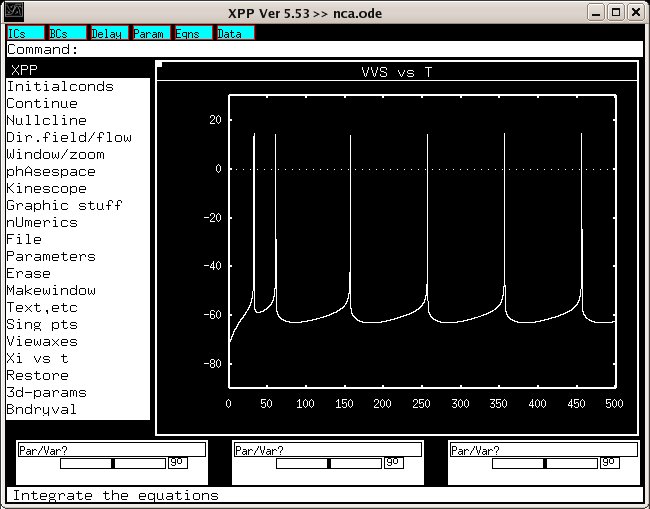
nca.ode : XPP file for Fig. 8Aa (normal [Ca^2+]_0).
casup.pdf: figure that shows activation curves, inactivation curves and
time constants as functions of V.
If you have problems, E-mail me to golomb@bgu.ac.il
David Golomb
Usage instructions:
xppaut nca.ode or similar startup graphically and then clicking on
Initialconds and then Go should
reproduce figure 8Aa:

The other file, zca.ode, figure 6Da: