
| Simulator: pysces 1.0.0 | |
| CPU cores: 1 | |
| RAM: 8 GB | |
| Max time: 20 m |
| Submitted: 2022-02-05 04:23:52 PM | |
| Updated: 2022-02-05 04:24:38 PM | |
Status: Succeeded |

- Stuart J. Edelstein
- Olivier Schaad
- Eric Henry
- Daniel Bertrand
- Jean-Pierre Changeux
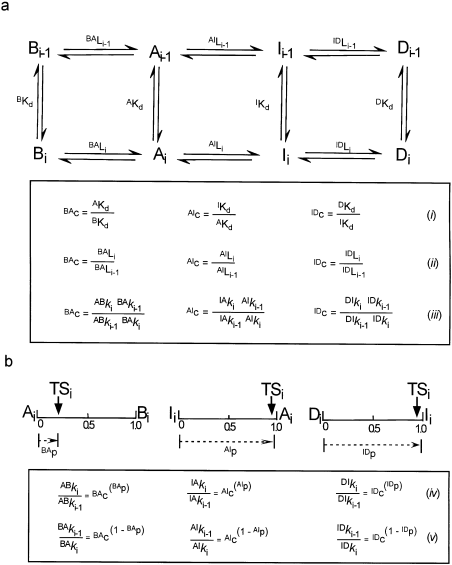
A kinetic model that links conformational interconversion rates to agonist binding and extends the general principles of the Monod-Wyman-Changeux model of allosteric transitions. The crucial assumption is that the linkage is controlled by the position of the interconversion transition states on a hypothetical linear reaction coordinate. Application of the model to the peripheral nicotine acetylcholine receptor (nAChR) accounts for the main properties of ligand-gating, including single-channel events, and several new relationships are predicted. Kinetic simulations reveal errors inherent in using the dose-response analysis, but justify its application under defined conditions. The model predicts that (in order to overcome the intrinsic stability of the B state and to produce the appropriate cooperativity) channel activation is driven by an A state with a Kd in the 50 nM range, hence some 140-fold stronger than the apparent affinity of the open state deduced previously. According to the model, recovery from the desensitized states may occur via rapid transit through the A state with minimal channel opening, thus without necessarily undergoing a distinct recovery pathway, as assumed in the standard 'cycle' model. Transitions to the desensitized states by low concentration 'pre-pulses' are predicted to occur without significant channel opening, but equilibrium values of IC50 can be obtained only with long pre-pulse times. Predictions are also made concerning allosteric effectors and their possible role in coincidence detection.